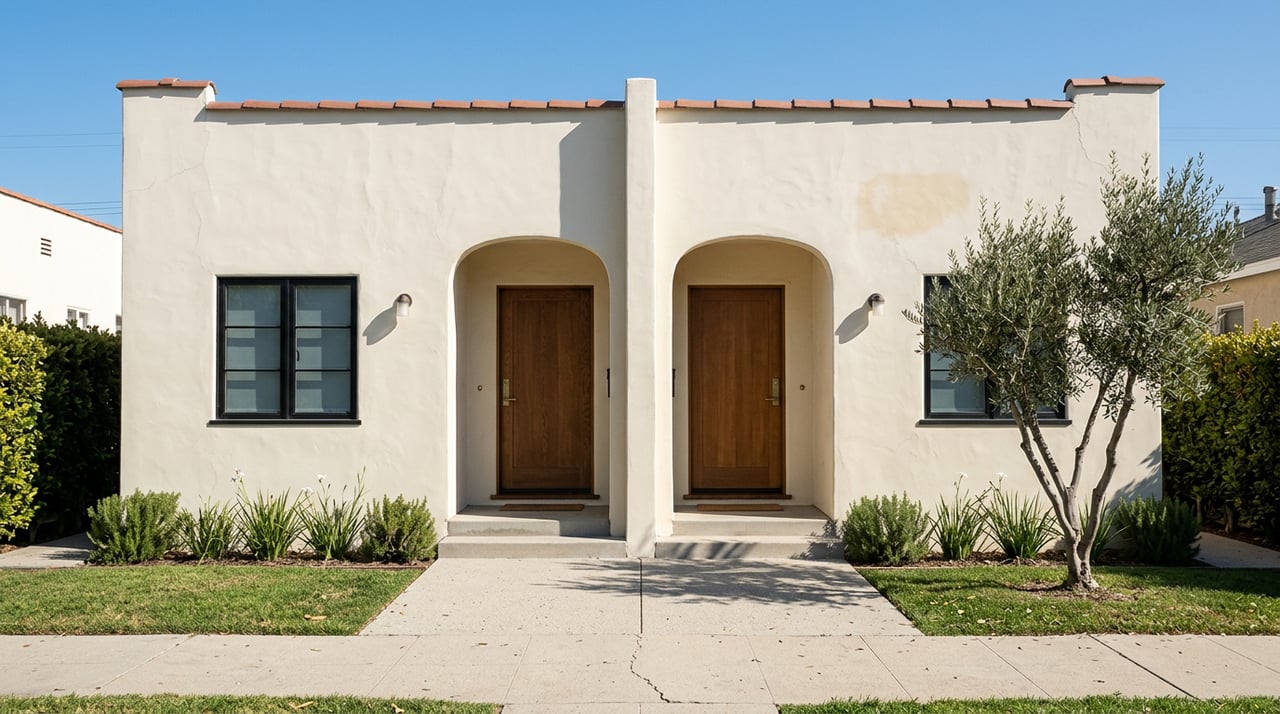
In December 2025, a 53-unit apartment building at 10216 Vultee Avenue in Downey sold for above its asking price. The deal closed at a 4.5 percent cap rate and an 11.8 gross rent multiplier, brokered by Todd Hawke, Michael Toveg, and Robert Stepp, and it stood out enough in the local trade press to be flagged as the second-largest multifamily transaction in Downey since January 1, 2024. On paper, a 4.5 percent cap rate in this market looks conservative. Buyers were still lining up.
Ask around and you'll hear the obvious explanation: good bones, gated parking, a pool and spa, copper plumbing already updated, roughly 27 percent rental upside still on the table. All true. But the detail that actually separated this listing from a dozen others quietly sitting on the market wasn't the cap rate at all. It was a box that had already been checked, one that most buyers scanning Downey listings this month haven't thought to ask about yet.
What the cap rate range actually tells you (and what it doesn't)
Recent commercial listings for Downey apartment buildings show cap rates ranging from roughly 3.8 percent to just under 6 percent as of mid-2026. One brokerage's tracking of closed Downey multifamily sales put the average cap rate closer to 4.0 percent, with an average sale price per unit around $237,100 and deals typically taking about five months to close, often settling roughly 8 percent below the original asking price.
That's a wide enough spread that the number alone doesn't tell you much. A building priced to a 6 percent cap rate isn't automatically the better deal. Sometimes it's priced that way because a buyer will need to spend real money before the rent roll matches the marketing flyer. A gross rent multiplier, the sale price divided by annual gross rent, tells a similar story from a different angle. Two buildings a block apart can carry nearly identical GRMs and still represent very different amounts of near-term work.
As of July 2026, a scan of active listings found roughly eight multifamily properties for sale in Downey, with asking prices spanning from under $800,000 to more than $6 million. That range covers everything from a modest duplex to a gated complex with dozens of units, which means the cap rate you see quoted is only meaningful once you know what condition the building is actually in.
The deadline that just landed on every 3+ unit listing
Here's the part that hasn't fully worked its way into how buyers price these deals yet. Senate Bill 721 requires owners of rental buildings with three or more units to inspect every exterior elevated element, meaning balconies, decks, stairways, and walkways more than six feet off the ground that rely on wood framing. The law was written after a balcony collapse in Berkeley in 2015, and it originally set a January 1, 2025 inspection deadline. Assembly Bill 2579 pushed that deadline back one year, to January 1, 2026.
That extended deadline has now passed. As of this month, any Downey apartment building with three or more units and a wood-framed balcony or stairway should already have a completed inspection report on file, and any deficiencies found should be on a 120-day repair clock. Owners who haven't done this face civil penalties that can run $100 to $500 per day, and in the event of an injury claim, an incomplete inspection becomes evidence of negligence rather than an oversight.
For a buyer, this changes what due diligence actually needs to cover on any Downey property with three or more units:
- Ask for the SB 721 inspection report directly, not a verbal assurance that "everything's fine."
- Confirm who performed it. The law allows licensed architects, engineers, or contractors holding an A, B, or C-5 license with at least five years of experience.
- If the report flagged repairs, check whether the 120-day window has already closed and what, if anything, was actually fixed.
- Ask your lender and insurer directly whether they require proof of compliance before closing. Both increasingly do.
- Note the recurring obligation. This isn't a one-time box to check. Re-inspection is required every six years.
A duplex is exempt from all of this, since SB 721 only applies at three units and above. That's worth knowing if you're comparing a duplex to a fourplex in the same price range, because the fourplex carries a compliance layer the duplex simply doesn't.
The building on Vultee Avenue that sold above asking had this handled. That's not the whole reason it drew multiple offers, but it's a meaningful part of why a buyer could underwrite it with confidence instead of building in a discount for an unknown repair bill.
Why Downey's rent rules matter more than the address
Separate from balcony compliance, there's a second local fact that changes how you should model rent growth on a Downey deal, and it has nothing to do with the building itself. Downey has never adopted its own rent control ordinance. The city's own housing division confirms that Downey rental properties fall under the statewide Tenant Protection Act, AB 1482, rather than a stricter local rule. That statute caps annual increases at 5 percent plus the local rate of inflation, up to a maximum of 10 percent, with the cap recalculated each August. A few years back, when a local rent control proposal came before the City Council, it was rejected unanimously.
Compare that to much of the rest of Los Angeles County, where cities including Los Angeles itself layer additional local rent stabilization rules on top of the state cap, often capping increases well below what AB 1482 alone would allow. That difference doesn't show up in a cap rate calculation. It shows up years later, in how much flexibility an owner has to bring an under-market unit up to current rents when a tenant moves out. If you're underwriting a Downey building using assumptions built for a Los Angeles County RSO property, you're likely being too conservative on achievable rent growth.
Current asking rents give a useful baseline for that underwriting. As of July 2026, studio units in Downey were listing around $1,795 a month, one-bedrooms in the high $1,800s to low $1,900s, and two-bedrooms near $2,470 to $2,495. Those figures give you a starting point for market rent, which then matters more in a city without a local cap layered on top.
The value-add lever most buyers overlook
One more piece belongs in this picture. Downey runs a pre-approved ADU plan program under Assembly Bill 1332, letting property owners select from construction documents the city has already reviewed and approved, which shortens the permitting timeline compared to a fully custom design. Right now, a multifamily lot in Downey can typically add up to two detached accessory dwelling units. Senate Bill 1211 opens the door to as many as eight detached ADUs on larger multifamily parcels, so long as the number doesn't exceed the existing unit count on the lot.
That matters directly to the math on a small multifamily purchase. A fourplex with room for even one additional detached unit isn't really a four-unit deal, it's a four-unit deal with a fifth income stream sitting in the backyard, waiting on a permit. Several current Downey multifamily listings already lean on this, describing lots with "great potential to add ADUs" as part of the pitch. Whether that potential is priced in or still sitting on the table is worth figuring out before you make an offer, not after.
Putting the pieces together
None of these four facts, cap rate range, SB 721 status, rent control exemption, and ADU headroom, tells the whole story on its own. Together they explain why two Downey listings with nearly identical cap rates can represent very different levels of risk and opportunity. The building with a completed balcony inspection, no local rent cap layered on top of AB 1482, and unclaimed ADU potential is doing more real work for your money than the one with a slightly better headline number and a quiet gap in its compliance file.
A few questions worth asking directly
Does SB 721 apply to my duplex? No. The law only applies to rental buildings with three or more units. A duplex is exempt regardless of balcony height or wood framing.
Is Downey rent controlled? Not by a local ordinance. Downey relies on the statewide AB 1482 cap, which limits annual increases to 5 percent plus local inflation, up to 10 percent. Several neighboring Los Angeles County cities impose stricter local limits on top of that state cap.
Can I add an ADU to a small apartment building I'm buying in Downey? In most cases, yes. Multifamily lots can currently add up to two detached ADUs, with the city's pre-approved plan program available to speed up permitting. That range is set to expand under state law for larger multifamily parcels.
If you're weighing a duplex, triplex, or fourplex in Downey and want to walk through what a specific listing's compliance status and rent history actually mean for your numbers, Team Sanchez works with small investors across Los Angeles County on exactly this kind of deal. Schedule your free consultation and bring the listing you're looking at. We'll go through it line by line.